Crucible Holders

Crucible Holders
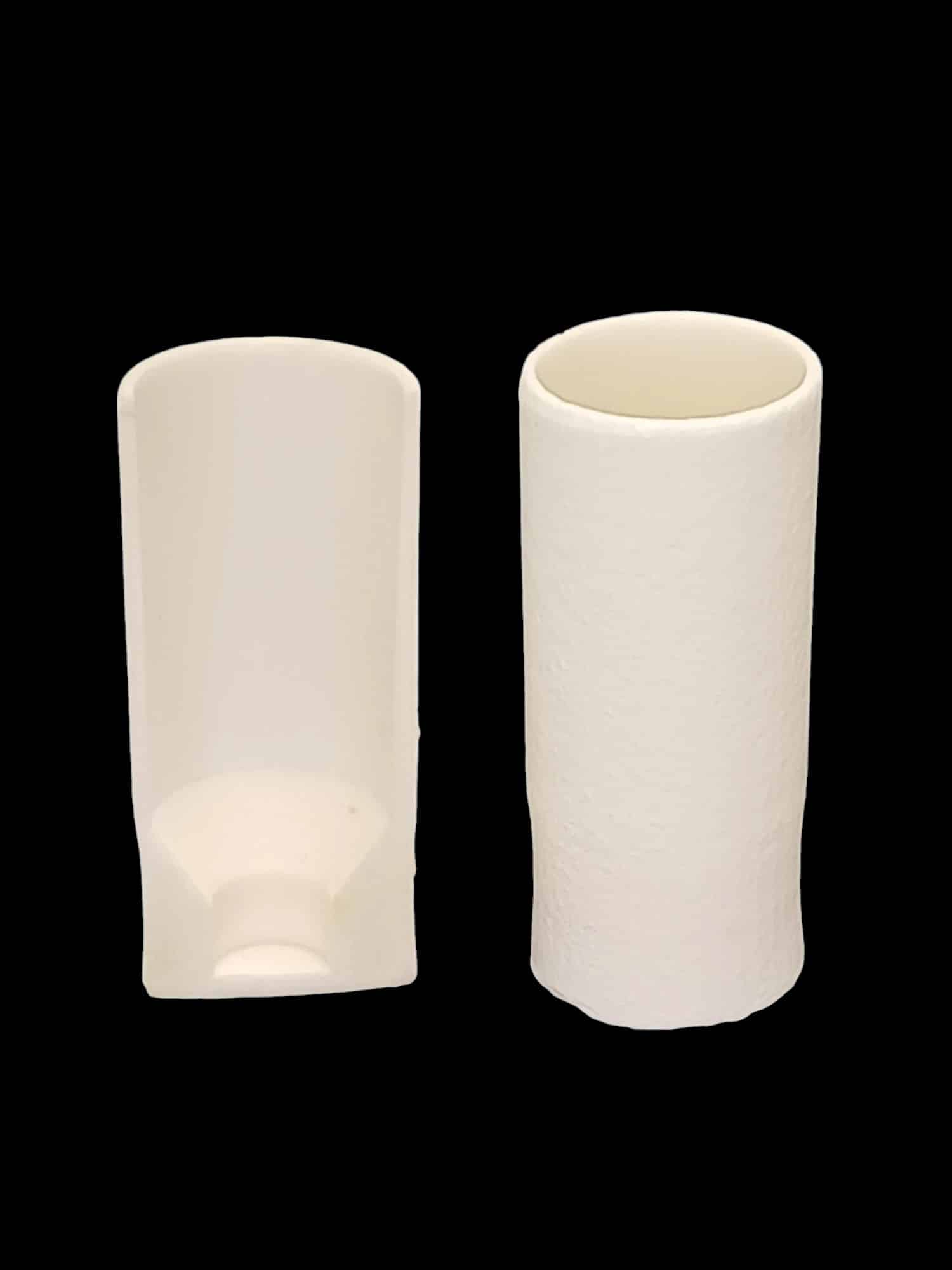
Crucible holders are often used when crucibles are removed from the furnace and need to cool without the risk of toppling. They are a good example of a geometry that is challenging to make by many common ceramic forming techniques. They have variable wall thickness, as the inner structure must follow the shape of the crucible to be held, yet the outer must provide stability. The wall thicknesses are often thick, and the holders are relatively large, and many have geometries with multiple features to spec tolerances.
The unique characteristics of iso-static pressing means that crucible holders can be manufactured with relative ease to a customer drawing. The uniform application of pressure that occurs during isostatic pressing means that relatively large, thick pieces of ceramic can be formed. If the shape can not be pressed directly, these features can be added later, either by machining in the green (unfired) condition, or after firing.
crucible holder outer and innerCrucible holders round end upSmall MgO Crucible holder

Developing Components Machined To Drawings

Almath frequently manufactures ceramic components to customer drawings. Our slip casting and pressing capability mean that nearly any quantity, size, shape and dimension can be produced from alumina, magnesia or zirconia.

The brittle nature of ceramics often means that they are challenging to form, and often components with only small and simple shapes can be made from the traditional processes. Iso-static pressing can be used to manufacture parts in low to high volume, either by pressing directly, or by pressing to a near net shape component that can be subsequent machined. In iso-static pressing the mould can be used almost immediately, without the need for drying leading to much higher production rates and higher capacity than slip casting. Almath is able to support customers in design for manufacture, whilst our range of manufactures techniques enable us to consider almost any component design.

Materiales disponibles

Almath es capaz de prensar crisoles y componentes de gran tamaño en una amplia gama de materiales cerámicos, entre los que se incluyen:

Esta alúmina es totalmente densa y tiene un porcentaje muy bajo de fase vítrea, lo que le confiere un mejor rendimiento que otras alúminas de menor pureza.

Óxido de magnesio totalmente denso, que contiene itria como coadyuvante de sinterización. La itria es inerte, equivalente al MgO y tiene el mismo rendimiento en todas las aplicaciones. Nuestros crisoles de MgO son de alta pureza, con un 99,21 % de MgO + Y2O3.

Ofrecemos una gama completa de circonias, estabilizadas con itria, cal o óxido de magnesio en diversas concentraciones para obtener policristal de circonia tetragonal (TZP), circonia parcialmente estabilizada (PSZ) y circonia totalmente estabilizada (FSZ).

Las alúminas endurecidas con circonio pueden ser una forma rentable de mejorar el rendimiento de la cerámica mediante la adición de circonio para dispersar las grietas y fijar los límites de los granos de alúmina. Nuestro ZTA estándar utiliza circonio 10% añadido a la alúmina, pero hay otros grados disponibles.

Almath es capaz de desarrollar materiales según los requisitos de los clientes.

Típico
Solicitudes

Almath focuses mainly on high purity, high density materials for crucibles and components. These materials are particularly suited to applications where contamination is a key concern. Our materials are also suitable for a range of other technical ceramic applications, where high performance properties are required in demanding conditions. Applications include, but are not limited to:
  • Battery and advanced material synthesis
  • Mineral refining and metal assaying
  • Biomedical applications
  • Aeroespacial
  • Nuclear
  • Vidrio
  • Research and development

¿Necesita ayuda con una solución personalizada?
Póngase en contacto con nuestro equipo hoy mismo.

Contacto comercial

Copyright © 2026. Almath Crucibles Ltd. (incorporated 1996). All rights reserved.

Nº de registro de la empresa: 3167902