1.Control Heating and Cooling Rates
The most effective way to prevent cracking is to control the rate of temperature change. Ceramics should be heated and cooled gradually to allow thermal gradients to equalise throughout the material. As a general rule, the thicker the part, the slower the ramp rate should be. For laboratory furnaces, a ramp rate of 150 °C -300 C per hour is often safe for alumina or zirconia crucibles. If rapid cooling is unavoidable, introducing a “soak” period near critical temperature zones can help equalise internal temperatures before proceeding further.
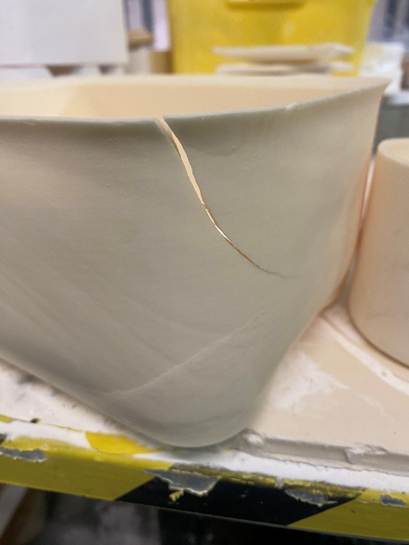
The curve crack shown above is typical of failure caused by uneven heating and cooling (thermal shock) it occurs more often during cooling than heating.
2. Choose Thermally Robust Materials
Not all ceramics handle heat in the same way. Alumine et zircone offer high thermal shock resistance compared with more brittle materials like fused silica or magnesia. Zirconia, for example, has a relatively low thermal conductivity, which helps prevent rapid heat transfer through the body. When selecting a material, consider both the working temperature and how quickly the component will be cycled. For applications involving sudden heating—like metal assay or rapid sample testing—zirconia is often the best choice.
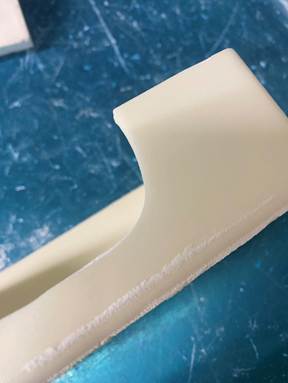
Above picture showing a crack which has propagated in the corner of a thick walled dense sagger. Cylindrical shapes items tend to be more robust than items with corners.
3. Use the Correct Forming Process
The manufacturing method also plays a key role in a ceramic’s performance. Isostatically pressed parts are generally more uniform and dense than slip-cast pieces, which means fewer internal flaws that could act as crack initiators. On the other hand, extruded or cast components can be better for complex shapes or where thermal gradients are less severe. Always ensure the forming process matches the application’s thermal and mechanical stresses.
4. Protect Ceramics from Direct Heat
Direct exposure to heating elements or flames can create extreme local temperature differences. Use a substrate or support plate—for instance, an alumina setter plate or refractory slab—to distribute heat evenly beneath the component. In induction or open-flame environments, shielding or secondary containment can prevent hot spots from developing.
5. Allow for Expansion Inside Crucibles
When heating materials within a crucible, always ensure there is adequate expansion room. Metal or glass samples expand as they heat, and if confined too tightly, the resulting pressure can crack even the strongest ceramics. Leave a small gap between the charge and the crucible walls and avoid overfilling or packing.
6. Maintain Distance from Heat Sources
Ceramics should not be placed too close to heating elements or burners. Proximity can create rapid, uneven heating, especially in furnaces with directional elements. A gap of several centimetres—depending on furnace size and heat intensity—helps reduce localised stresses.
7. Handle with Care After Heating
Finally, remember that ceramics remain vulnerable when hot. Avoid sudden contact with cold tools or surfaces, and never quench a hot crucible in water or air. Let it cool naturally in the furnace or an insulated chamber.
In summary: preventing thermal shock comes down to understanding heat flow, material choice, and mechanical design. With controlled temperature changes, the right substrate, proper forming methods, and thoughtful operation, high-temperature ceramics can last for many cycles without cracking—saving both time and cost.




 English (UK)
  Français
  Deutsch
  Español
  Italiano
  Polski