Quartz and ceramic materials are prized in industrial settings for their ability to withstand extreme temperatures and resist chemical corrosion. Whether used in laboratory equipment or high-heat manufacturing, these materials provide stability where others might fail. However, because they are exceptionally hard and brittle, working with them requires specific knowledge and the right tools. Which means learning how to cut quartz tube or ceramic piping safely is essential for protecting both the operator and the integrity of the material.
Applications Of Quartz Tubes In Industry
You will find quartz tubes in a vast range of demanding environments. Because they have a very low coefficient of thermal expansion, they can handle rapid temperature changes without cracking. This makes them ideal for semiconductor manufacturing, where precision and purity are vital. They are also widely used in ultraviolet (UV) sterilisation systems, as quartz allows UV light to pass through with very little interference.
In research and industrial heating, these tubes often serve as the core component of a quartz tube furnace. In these setups, the tube acts as a chamber where samples are heated to high temperatures under controlled atmospheres. Beyond heat resistance, quartz tubes offer excellent electrical insulation and chemical high-purity, making them indispensable in the chemical processing and lighting industries.
Essential Safety Precautions
Before you begin the process of how to cut quartz tube or ceramic components, you must prepare your workspace. Safety is the most important part of the job. Cutting these materials produces fine, sharp dust and potentially flying shards. You should always wear high-quality safety goggles and a proper dust mask or respirator to avoid inhaling silicate particles.
It is also wise to wear cut-resistant gloves, though you must ensure they do not interfere with your grip on the machinery. If you are using a wet saw, ensure your electrical connections are safe and the water supply is consistent. Because quartz and ceramics are brittle, they can shatter if too much pressure is applied. Always work in a well-lit area and keep your hands clear of the cutting path.
Cutting Techniques For Quartz Tubes
There are several ways to approach cutting, depending on the thickness of the material and the required precision. For thin-walled tubes, a simple ‘score and snap’ method is often used. This involves using a glass cutter or a diamond file to create a clean line around the circumference. By applying gentle, even pressure, the tube should break cleanly along the scored line.
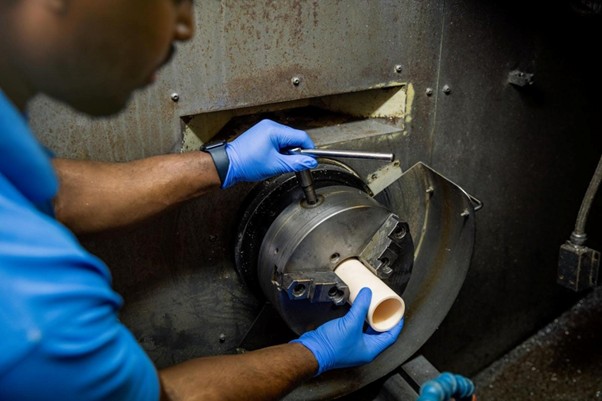
For thicker walls or high-volume work, a diamond saw is the preferred tool. A circular saw with a diamond-tipped blade provides a much straighter and more consistent edge. It is common practice to use a ‘wet cut’ method where water cools the blade and suppresses dust. In some advanced manufacturing settings, laser cutting ceramics and quartz has become more common. This method uses high-energy beams to vaporise the material along a path, offering extreme precision without the physical stress of a blade.
Finishing Techniques: Cut Finish And Flame Polish
Once the cut is complete, the edges will likely be sharp or slightly jagged. Leaving the material in this state can lead to cracks or chips that spread under thermal stress. The simplest finishing method is a mechanical grind. This involves using silicon carbide or diamond abrasives to smooth the edge. This is known as a cut-and-ground finish, which leaves the edge matte and smooth to the touch.
If you require a perfectly clear and rounded edge, you may choose a flame polish finish. This involves using a high-temperature torch to slightly melt the edges of the quartz tubes. The heat rounds off any microscopic cracks and leaves the end of the tube looking transparent and polished. This process not only looks better but also significantly strengthens the edge against future breakage.
Using A Quartz Tube Furnace
After cutting and finishing your tube to the correct length, it may be intended for use within a quartz tube furnace. These furnaces rely on the tube to hold a vacuum or a specific gas mix while heating materials to temperatures often exceeding 1000°C. If the tube has been cut poorly or has micro-cracks at the edge, the intense heat can cause the tube to fail mid-process.
When installing a tube into the furnace, ensure that the support brackets and seals are aligned correctly. Uneven pressure on a freshly cut tube can cause stress points. By ensuring your cutting and finishing techniques are up to professional standards, you extend the life of your equipment and maintain the safety of your laboratory or factory floor. While laser cutting ceramics is a great way to ensure precision for small components, traditional diamond cutting remains the backbone of preparation for larger furnace tubes.
Talk To Almath Crucibles About Your Requirements
If you need high-quality materials or advice on the best components for your high-temperature applications, the team at Almath Crucibles is here to help. We provide a wide range of quartz tubes and ceramic solutions tailored to your specific industrial needs.
Get in touch today to talk through your project. Whether you are looking for standard sizes or custom specifications, we can help you find the right fit for your quartz tube furnace or laboratory setup. Let us help you move forward with your work with more confidence and the best materials available.



 English (UK)
  Français
  Deutsch
  Español
  Italiano
  Polski