One of the most common questions we receive is whether ceramic components should be machined before or after firing. The answer depends on the geometry, tolerances, production volume, and performance requirements of the finished part.
Weiterlesen: Green Machining vs Fired Machining: Which Process Is Best For Your Application?
There are two main approaches to ceramic machining: green machining and fired machining. Green machining is carried out on unfired ceramics before sintering, while fired machining takes place after firing where tighter tolerances and higher precision are required. Understanding the strengths and limitations of each process helps ensure the most appropriate manufacturing route is selected for your application.
The Advantages Of Green Machining
At Almath, green machining is often used where customers require complex ceramic components that would be difficult or expensive to manufacture after firing. It is particularly useful during product development projects where designs are still evolving or when rapid prototype iterations are required.
Because the material is easier to machine before firing, complex geometries can often be produced more quickly and with significantly lower tooling costs than machining fully fired ceramics.
Machining components while they remain in an unfired state offers several manufacturing advantages. Unfired ceramics are held together by a sacrificial polymer binder, leaving the body ridged in shape, but soft enough to machine without chipping. Consequently, green machining is faster and less restrictive than working with fully dense ceramics.
- Rapid Material Removal: Because the body is weak, standard cutting tools can carve through raw material at higher feeds and speeds. This removes bulk volume in a fraction of the time required for fully dense alternatives.
- Tooling Flexibility: Operators do not need expensive, industrial diamond grinding tooling to shape unfired ceramics. Standard carbide tools work effectively, keeping tooling wear down and initial setup costs predictable.
- Complex Intricate Geometries: Delicate internal threads, deep blind holes, and complex external undercuts can be shaped far more safely when the material is easily worked.
The high speed and lowered mechanical resistance make this methodology highly attractive for custom development work. Green machining supports complex shapes, prototypes, and low-to-medium volumes where rapid component iterations are necessary.
The Case For Precision-Fired Machining
Where components require very tight tolerances, fine surface finishes, or accurate mating surfaces, we will often recommend fired machining. Although it is slower and requires specialist tooling, machining after sintering delivers the highest levels of dimensional accuracy.
During the sintering process, raw components shrink significantly. This contraction often ranges from 15% to 30%, depending on the specific formulation and forming technique.
Predicting this shrinkage precisely across variable geometric cross-sections presents a significant challenge. For projects demanding absolute dimensional control, fired machining delivers tighter tolerances and smoother finishes. Once a ceramic component completes the sintering cycle, its physical dimensions remain fixed and can be machined to size.
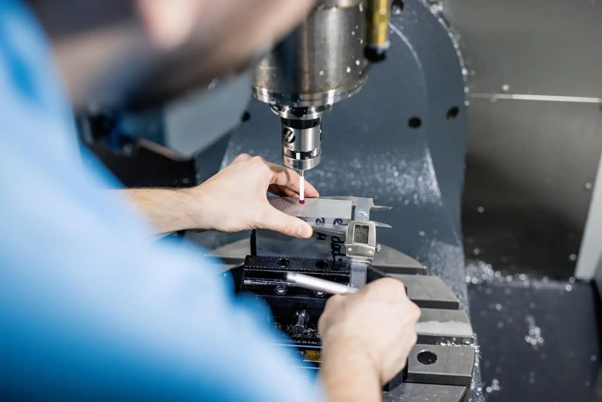
The main drawback to this approach is the abrasion resistance of the ceramic. Fired ceramics achieve high precision but require slower machining and diamond tooling due to their extreme hardness. The material has a similar hardness to sapphire such that traditional lathe tooling will blunt rapidly. Instead, production facilities must utilise high-precision CNC grinding, diamond coated tooling, and carefully controlled processing speeds to achieve tightly toleranced designs.
Balancing The Substrates: A Two-Stage Hybrid Approach
To capture the benefits of both production techniques, advanced facilities often implement a combined multi-stage workflow. Green machining may require fired finishing later to satisfy the contrasting engineering demands.
In this case, a component is roughly machined before firing to remove the bulk of the excess waste material. The component is deliberately left slightly oversized to provide a structural safety margin. Following the furnace cycle, high-precision grinding equipment removes the final fractions of a millimetre from critical interfaces. This combined technique minimises the volume of material that must be processed in a hardened state, lowering overall cycle times while preserving critical engineering tolerances.
Material Control Improves Machining Accuracy
The success of either processing pathway depends directly on the initial consistency of the raw substrate block. Uniform pressed billets help achieve tighter tolerances on green parts and reduce material removal on fired parts. If the initial compaction pressure varies across the blank, the component will shrink unevenly in the kiln, causing predictable dimensions to warp.
Using uniformly pressed billets makes shrinkage during sintering far more predictable, helping to improve dimensional consistency and reduce the amount of finish machining required. At Almath Crucibles, our advanced pressing capabilities ensure that blocks intended for green machining maintain completely homogeneous internal density profiles. This baseline consistency improves processing reliability and limits the final finishing operations required on fired ceramics, keeping production costs highly competitive.
Summary Of Operational Differences
To help configure your next custom design, the general parameters of each material processing pathway are outlined below:
- Green Machining: Maximises removal speed and supports complex design features; ideal for low-volume development but requires compensation for kiln shrinkage.
- Fired Machining: Maximises surface smooth quality and achieves tight mechanical tolerances; requires diamond tooling and experiences higher processing wear.
In practice, the most appropriate machining method depends on the component geometry, tolerance requirements, production volume, and the overall manufacturing route. In many projects, combining green machining with selective fired finishing provides the best balance between manufacturing efficiency and precision.
Sprechen Sie mit Almath Crucibles über Ihre Anforderungen
Every ceramic component presents different manufacturing challenges. Our technical team works closely with customers to determine whether green machining, fired machining, or a combination of both will deliver the most efficient and cost-effective solution. Whether you’re developing a new ceramic component or refining an existing design, we can help identify the most appropriate manufacturing route for your application.
Get in touch with our specialist team today to discuss your next ceramic machining project.


 English (UK)
  Français
  Deutsch
  Español
  Italiano
  Polski