1. Receive the customer drawing and capture the real requirements
Everything starts when a customer sends a drawing or specification and asks, “Can you make this?” Our first job is to make sure we understand what they actually need — not just what’s written on the drawing.
At this stage, we collect:
- 2D drawing + any 3D files (STEP/IGES preferred if available)
- Material requirement (alumina grade, purity, whether it’s our standard body or a specific customer body)
- Finished tolerances (critical dimensions vs. non-critical dimensions)
- Surface finish expectations (even if they don’t specify Ra, we clarify what “good finish” means for them)
- Quantity (Almath does lots of one-offs, so the process must be efficient for single parts)
- Functional features (what matters most: sealing faces, bores, flatness, concentricity, etc.)
A key early question is: Are tolerances specified on the fired part or the green part? At Almath, we treat customer tolerances as final fired tolerances, and we build our process around achieving them after shrinkage and firing.
2. Team feasibility review (can we do it in-house?)
Next, we discuss the part as a team and decide whether it’s achievable with our equipment and process. This is where experience saves time and prevents scrap.
We review:
- Geometry risk: thin walls, long slender sections, deep pockets, sharp internal corners, tiny holes, fine threads, or delicate edges
- Machinability in the green state: Will features survive clamping, tool entry, and vibration?
- Fixturing options: can we hold it securely without crushing or deforming it?
- Tool access: Can tools reach features without excessive stick-out?
- Metrology: can we measure what’s needed reliably (in green and fired state)?
- Shrinkage sensitivity: Will shrinkage variation push us out of tolerance?
If the answer is no, we either propose changes (feature tweaks, tolerance relaxation, design for manufacturability suggestions) or decline. If the answer is yes, we move forward.
3. Design a 3D model and define a machining datum strategy
If we can make it, we build a 3D model of what the customer requires (or confirm/repair their CAD).
At Almath, datum strategy matters because:
- Green parts are fragile
- Features can move slightly during firing
- We need repeatable setups and reliable referencing
We decide:
- Primary datums: what surfaces we’ll use as our “truth” during machining
- Setup sequence: what gets machined first to create stable datums for later operations
- Allowance approach: where we leave extra material to protect edges or maintain rigidity
For one-offs, it’s common that the first version of the process is the process-development version, so we build the CAD/CAM with that in mind.
4. Understand shrinkage and tolerance risk (before cutting anything)
This is one of the biggest differences between normal machining and green machining ceramics:
The part you machine is not the final size.
Before we commit to final toolpaths, we assess:
- Expected linear shrinkage range for the specific alumina body and firing cycle
- Whether shrinkage is likely to be uniform across the whole part
- Which features are tolerance-critical (these drive the shrinkage validation plan)
Important reality at Almath: Not every part shrinks the same, and not every feature shrinks the same. Thick/thin transitions, long bores, pockets, and unsupported geometry can shrink differently or distort.
So we don’t just apply one shrink factor and hope. We validate.
5. Make sample parts to measure real shrinkage (feature-by-feature)
For tight tolerance work, we produce test pieces/sample parts and fire them. These are designed to mimic the tricky features of the real part, such as:
- Bores
- Thin walls
- Steps and shoulders
- Slots
- Flatness-critical faces
- Edge conditions (chamfers, radii)
- Any feature likely to chip or distort
After firing, we measure both:
- Green dimensions (before firing)
- Fired dimensions (after firing)
Then we calculate shrinkage:
- Overall shrink factor (useful as a baseline)
- Feature-specific shrink/variation (what we actually care about)
This is how we protect ourselves and the customer when tolerances are tight: we use measured shrinkage, not guessed shrinkage.
6. Build the shrinkage model into CAD and CAM (oversize correctly)
Once we have shrinkage data, we create the green machining target size.
Typical approach:
- Apply an overall scaling factor first
- Then adjust certain features based on observed behaviour (if needed)
For example:
- A long bore might shrink slightly differently from the external diameter
- Thin walls may distort more
- Flats or sealing faces may need extra stock or special support during firing
At Almath, the goal is simple: the fired part meets tolerance, even if the green part looks “oversized” or slightly odd compared to the final drawing.
7. Plan fixturing specifically for fragile green alumina
Fixturing is often where green machining succeeds or fails.
Green alumina can:
- Crack under point loads
- Chip at edges
- Deform slightly if clamping is uneven
- Shed particles (which then cause poor surface finish)
So our fixturing principles are:
- Spread clamping loads: avoid concentrated pressure
- Use soft interfaces where appropriate (to prevent bruising)
- Support thin features during machining
- Avoid aggressive re-clamping: minimise setup changes where possible
- Keep it clean: dust and chips can become damage points
For one-offs, we may make simple custom supports or soft jaws, because it’s cheaper than scrapping a part.
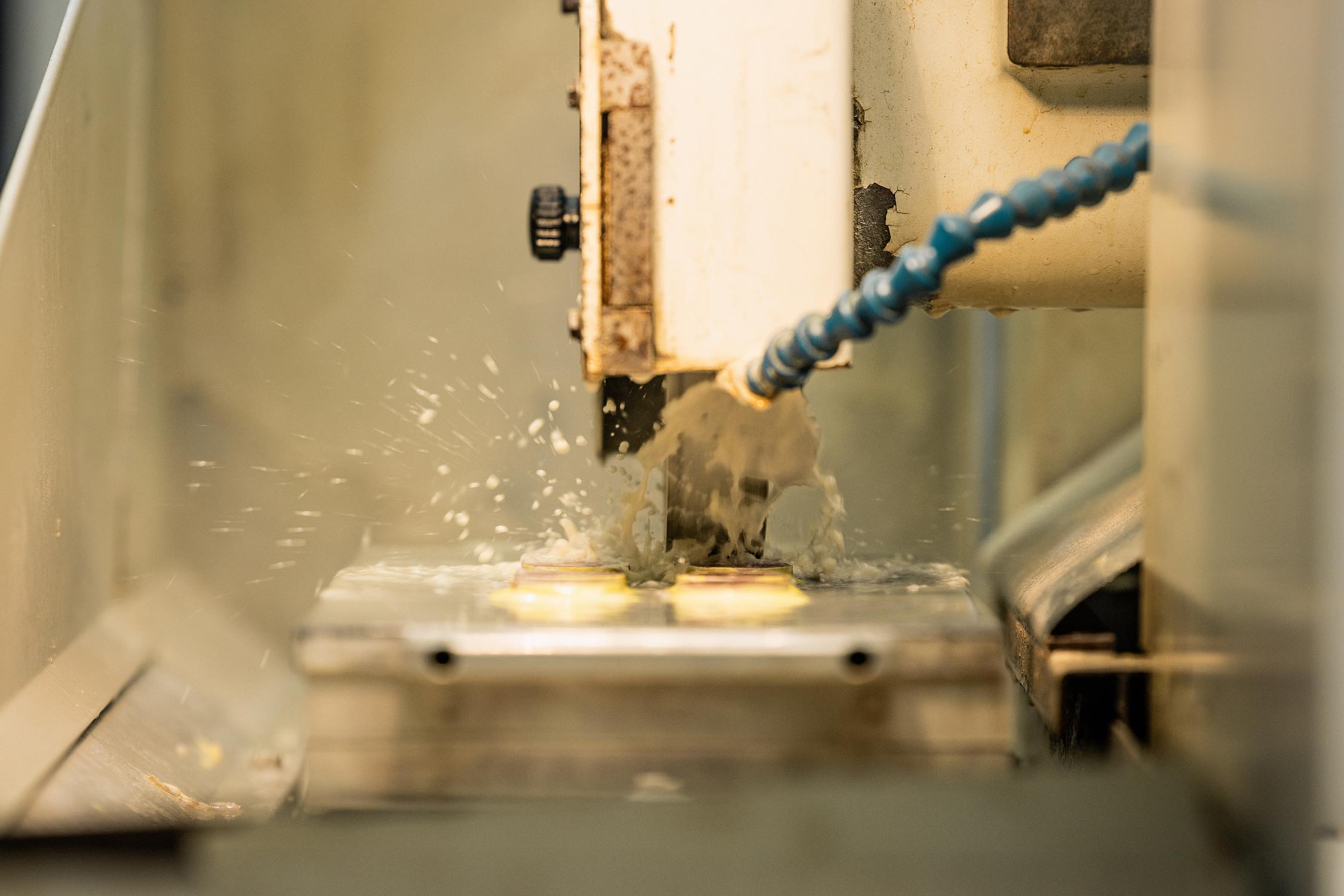
8. CAM programming and proving out on the HAAS Mini Mill
Once we’ve got the correct green dimensions, datums, fixturing plan, and tooling strategy, we program in CAM.
At Almath, because we do many one-offs, the CAM stage often includes “learning the part”:
- Which features cut cleanly
- Which ones tend to chip
- Where we need to leave extra stock and come back lightly
- Whether the part needs a different sequence to stay rigid
We then post-process for the HAAS Mini Mill and prepare:
- A setup sheet (datums, tools, key notes)
- Tool list and tool lengths
- Any special warnings (fragile edges, do not over-tighten clamps, etc.)
Before cutting a real part, we typically:
- Run a careful simulation in CAM
- Do an air cut / dry run on the machine
- Confirm that tool clearances and work offsets are correct
9. Machine setup: alignment, offsets, and gentle handling
On the Mini Mill, we aim for a setup that is:
- Repeatable
- Stable
- Easy to re-check without disturbing the part
Green machining requires good habits:
- Handle parts gently and consistently
- Avoid bumping corners during loading/unloading
- Confirm datum surfaces are clean and seated properly
- Re-check offsets if anything changes
This is also where we ensure:
- The part is supported properly (especially thin floors/walls)
- There’s no vibration risk from poor support or tool overhang
10. In-process inspection (green stage) and adjustments
We inspect critical features while machining, because small adjustments here can save the part.
This includes:
- Checking key dimensions against green targets
- Confirming feature quality (edge chipping, breakout, surface condition)
- Comparing the reality to our shrinkage assumptions
Minor adjustments are normal:
- Tiny CAM edits
- Extra light finishing pass
- Adjusting the toolpath approach or direction to improve edge quality
Because Almath does many one-offs, we treat this as part of our standard craft: we learn quickly, and we capture what works.
11. Final green inspection and preparation for firing
Once machining is finished, we inspect:
- Critical dimensions (relative to green targets)
- Overall geometry and visible defects
- Edge condition and surface quality
Then we prep for firing:
- Ensure the part is clean (loose dust can mark surfaces)
- Support the part appropriately for the firing process to reduce distortion risk
- Label/track it so we can match results to the shrinkage records
12. Firing, post-fire inspection, and tolerance verification
After firing, we measure against the customer drawing (final dimensions).
We pay close attention to:
- Dimensions that historically show variation
- Features that may distort (thin sections, long bores, wide flats)
- Concentricity/flatness if required
If the part is within tolerance: perfect — that’s the delivered product.
If something is off:
- We compare fired results to green measurements and shrink assumptions
- We refine our shrinkage model for next time
- For repeat work, this becomes a reliable baseline
13. Deliver the final product with documented learning for future one-offs
Even for one-offs, we capture what we learned:
- Actual shrinkage results
- Which toolpaths produced the best finish
- Which features were risky
- What fixture approach worked best
That way, the next similar job is faster, more reliable, and less wasteful.
Summary: Green Machining at Almath Crucibles Ltd
At Almath Crucibles Ltd, we offer a specialist green machining service focused on producing high-quality, precision alumina components, with a strong emphasis on one-off and low-volume parts. Our approach combines practical machining experience with a deep understanding of ceramic shrinkage, firing behaviour, and tolerance control.
From initial drawing review through to final fired inspection, we work closely as a team to assess feasibility, optimise part design, and develop reliable machining and shrinkage strategies tailored to each component. By producing and firing sample parts where required, we are able to calculate real, feature-specific shrinkage values rather than relying on assumptions, allowing us to achieve tight tolerances.
Using our HAAS Mini Mill and carefully developed fixturing, tooling, and programming strategies, we machine green alumina in a controlled manner that prioritises surface quality, edge integrity, and part stability. Fine adjustments during programming and machining allow us to minimise chipping and achieve the best possible finish before firing.
This process enables Almath to deliver custom, high-purity alumina components that meet demanding dimensional and quality requirements, even for challenging one-off designs. Our green machining capability is a key part of what allows us to offer flexible, reliable, and technically informed ceramic manufacturing solutions to universities, research organisations, and industrial customers worldwide.



 English (UK)
  Français
  Deutsch
  Español
  Italiano
  Polski