One of the most common challenges engineers face when manufacturing ceramic components is achieving intricate shapes without introducing damage to the material. Traditional machining methods can be highly effective for many ceramic components, but for thin, brittle, or high-purity ceramics, laser cutting often provides a more precise and reliable solution.
Leggi tutto: Laser Cutting Ceramics: Benefits, Applications, And When To Use It
By eliminating physical contact with the component, laser cutting ceramics allows manufacturers to achieve complex geometries, tight tolerances, and clean edges without introducing the stresses associated with conventional machining.
The Challenge Of Traditional Ceramic Machining
Industrial ceramics are notoriously difficult to reshape once they are fired. Because they are exceptionally hard and brittle, traditional mechanical cutting tools place large amounts of physical stress on the piece. This pressure often causes microscopic fracturing, chipping, or complete structural cracking along the cut line.
For high-spec applications, mechanical stress is not appropriate. And when your design requires intricate geometries, standard saws often fail to deliver. This is exactly where advanced processes like ceramic laser cutting bridge the gap, eliminating the forces of mechanical tools entirely.
When To Choose Laser Cutting Ceramics
Deciding whether to employ traditional diamond machining or look into what you can laser cut ceramic components with depends on your final design specifications. Knowing when to make the switch ensures you protect both your budget and the structural integrity of your materials.
1. When Traditional Machining Causes Chipping Or Cracking
Mechanical cutting discs rely on abrasion, friction, and physical force to work through a piece. With brittle technical ceramics, this mechanical load introduces micro-cracks that can quickly worsen under thermal stress later on. Laser cutting ceramics eliminates this risk by utilising a focused, high-energy light beam to cleanly vaporise or melt material, leaving the surrounding structure entirely undisturbed.
2. When Fine Features And Intricate Geometries Are Required
If your project requires fine holes or thin complex cross-sections, mechanical tooling quickly reaches its limits. A diamond drill bit cannot easily produce complex internal radiuses or delicate grids without snapping the substrate. Because a laser beam can be focused down to a fraction of a millimeter, ceramic substrate laser cutting makes the production of dense, intricate matrices and miniature components highly repeatable.
At Almath, laser cutting is often used where customers require precision slots, apertures, thin ceramic substrates, or intricate component profiles that would be difficult or uneconomical to achieve using conventional machining methods.
3. When Working With Brittle Or High-Purity Ceramics
In high-tech sectors like semiconductor manufacturing or aerospace engineering, purity is everything. Traditional mechanical tools wear down during use, potentially introducing metallic fragments or abrasive grit contamination into high-purity alumina or zirconia. Because laser systems never physically touch the material, the risk of surface contamination is removed.
This is particularly valuable for applications such as electronic substrates, laboratory components, and specialist ceramic parts where material purity and dimensional accuracy are critical.
4. When Tool Wear Makes Machining Inefficient Or Costly
Because industrial ceramics are often harder than standard cutting media, mechanical tools degrade at an alarming rate. Constant tool wear requires frequent machinery calibration, regular wheel dressing, and expensive replacement parts – all of which rapidly drives up operational costs. Implementing a non-contact system means there are no physical blades or bits to blunt, ensuring your long-term production costs remain predictable.
5. When Tight Tolerances Are Needed Without Post-Processing
Traditional cutting usually leaves a rough edge that requires secondary grinding or polishing steps to meet strict engineering tolerances. Precision laser systems achieve exceptional edge clarity and tight dimensional tolerances right from the initial pass. This clean finish cuts down on labor-intensive processing and speeds up your manufacturing timeline.
When Precision Matters More Than Bulk Volume
It is important to recognise that while you can laser cut ceramic parts with incredible accuracy, the technology is highly specialised. The process is optimised for thin, high-specification components rather than bulk, thick structural blocks.
The strategy works best when handling a delicate ceramic substrate laser cutting project, where precision, pristine surface quality, and repeatability are non-negotiable. For thin wafers, medical components, and custom laboratory insulators, laser profiling stands out as the ultimate production method.
Technical Overview Of The Ceramic Laser Process
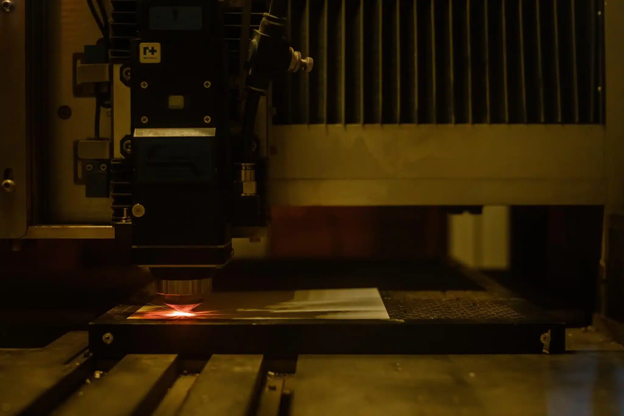
The underlying technology relies on a highly focused laser beam, often a CO₂ or fibre laser system, to rapidly heat the material past its melting or vaporisation point. Computer Numerical Control (CNC) software guides the beam with absolute accuracy across the workpiece.
To help configure your next project, the core operational boundaries of ceramic laser cutting are outlined below:
- Optimal Thickness Range: Most effective on substrates ranging from 0.25 mm up to 5.0 mm.
- Achievable Tolerances: Capable of maintaining tight tolerances down to ± 0.05 mm.
- Typical Materials: Ideal for alumina, zirconia, silicon nitride, and aluminum nitride.
- Surface Finish: Delivers a clean, smooth edge requiring minimal secondary processing.
Contatta Almath Crucibles per illustrare le tue esigenze
Every application has different requirements relating to material selection, component geometry, tolerances, and manufacturing processes. At Crogioli Almath, our technical team works closely with customers to determine the most appropriate production route for each application, whether that involves laser cutting, conventional machining, or an alternative ceramic manufacturing method.
If you’d like to discuss a ceramic component or explore whether laser cutting ceramics is the right solution for your application, get in touch with our team today.


 English (UK)
  Français
  Deutsch
  Español
  Italiano
  Polski