Selecting the right manufacturing option for technical ceramics is as critical as the material choice itself.
One of the most common questions we receive from customers developing new crucibles and ceramic components is whether a pressed or slip-cast component will provide the best combination of cost-effectiveness, durability, and thermal shock resistance. Both are established ceramic manufacturing methods, but the right choice depends on the application, material, performance requirements, and production considerations.
Dowiedz się więcej: Pressed Vs Slip Casting: Which Method Is Best For Industrial Use?
Understanding The Core Differences In Ceramic Forming Methods
To decide which path to take, first let’s look at how these ceramic forming methods physically shape the material.
Ceramika tłoczona: Pressing involves compacting dry or semi-dry ceramic powder within a rigid die or a flexible membrane under high pressure. This can be uniaxial (pressing from one direction) or isostatic (applying pressure from all sides). The result is a ‘green’ body ready for firing. Pressed ceramics are often preferred for high-performance applications where strength, consistency, and repeatability are critical, particularly for higher volumes.
Slip Casting: Slip casting is a more traditional, fluid-based process. A liquid ceramic slurry, or slip, is poured into a porous plaster-of-paris mould. The mould draws water out of the slurry, leaving a solid ceramic layer against the interior walls. It is a versatile technique, but it relies heavily on the capillary action of the mould and the manual skill of the technician. Small volumes and prototypes can be produced rapidly as there is little tooling required. However, mainly hollow shapes can be made by this method.
Why Pressed Ceramics Lead In Industrial Performance?
In many industrial applications, the decision between pressing and slip casting comes down to performance requirements. Customers often approach us looking for the most reliable solution for demanding environments, whether that’s high temperatures, thermal cycling, aggressive chemicals, or the need for consistent repeatability across multiple components.
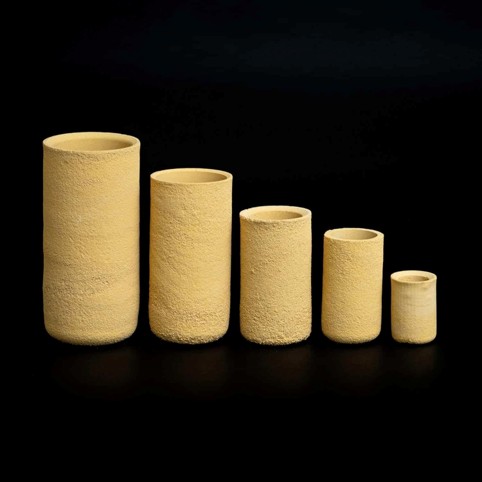
In many cases the choice of process comes down to the design of the crucible. For thin walled crucibles slip casting is often best. However, if thicker walls are used pressed ceramics can provide a combination of strength, consistency, and long-term reliability. The high, uniform pressures used during the forming stage ensure that the ceramic grains are packed tightly together, reducing internal voids and creating a more uniform structure and creating a consistent density throughout the component. This reduces differential shrinkage during firing and lowers the risk of defects or weak points developing within the finished ceramic. Furthermore Isostatic pressing allows crucibles to be made from a range of powder sizes. This allows Almaths’s engineers to control the porosity and produce thermal shock resistant ceramics. These crucibles are ideal for rapid heating such as induction melting of alloys, over many heating cycles.
Key advantages include:
- Higher Density And Strength: The compaction process creates a more robust microstructure, reducing the chance of mechanical failure.
- Superior Consistency: Pressing is a highly repeatable process. Once tooling has been established, components can be produced with a high degree of consistency from batch to batch.
- Thermal Shock Resistance: The ability to control porosity during pressing allows thermal shock resistant ceramics to be produced for applications involving rapid heating and cooling.
- Tailored Material Performance: Pressing also allows ceramics to be engineered for different applications. Fully dense pressed ceramics provide maximum strength and chemical resistance, while deliberately porous pressed ceramics offer exceptional thermal shock resistance for demanding thermal environments.
While pressing generally requires a greater upfront investment in tooling, the long-term performance, repeatability, and reliability of the finished components often justify the additional setup effort. Almath has its own in-house tool room and can make bespoke tooling quickly and cost effectively.
When To Choose Slip Casting For Your Project?
Despite the mechanical advantages of pressing, slip casting remains a vital tool. It excels in areas where high-pressure dies simply cannot reach.
Intricate Geometries And Prototypes: If your design features complex internal cavities, thin walls, or irregular shapes, slip casting is often the only viable route. The slip flows into every corner of the mould, it can capture detail that a rigid press cannot.
Cost-Effectiveness For Low Volumes: For researchers or startups requiring only a handful of parts, before further modification, the cost of CNC-machined steel dies for pressing can be prohibitive. Slip casting moulds are made from inexpensive plaster.
This makes slip casting particularly well suited to bespoke scientific components, early-stage development projects, and smaller production runs where designs may still evolve before a final production method is selected.
Precision, Tolerances, And Defect Risks
Precision is where the gap between these ceramic manufacturing methods becomes most apparent. In industrial ceramics, tolerance refers to how much the fired part deviates from the intended dimensions.
Pressed methods inherently offer tighter tolerances. Because the starting material has lower moisture content, there is less shrinkage during the drying and firing stages. Furthermore, modern isostatic pressing provides a uniform density across the entire part, which can improve the life of the crucible..
In contrast, slip casting carries a higher risk of variability. Without good control over the slip properties and mould quality there would be wider dimensional variation, and increased likelihood of cracks forming during the firing cycle. For higher volume applications, the repeatability of pressed ceramics is almost always preferred.
Scaling For Production: More Than Just Volume
At Almath Crucibles, one of the questions we often ask customers is not simply “How many do you need?” but also “What material are you using, what tolerances are required, and how likely is the design to change?”
While production volume is an important consideration, it is rarely the deciding factor on its own. Material selection, geometry, tolerances, and application requirements often have a greater influence than volume alone.
In general, pressed ceramics become increasingly attractive where consistency, repeatability, and long-term production stability are priorities. The initial tooling investment is higher, but the process can deliver highly consistent components with excellent repeatability over multiple production runs.
Slip casting, meanwhile, offers greater flexibility during development work and for components with particularly complex geometries. Where designs are still evolving, modifying a mould is often more practical than investing in dedicated pressing tooling. We often see this approach used during product development projects where customers are refining designs before committing to dedicated production tooling.
In reality, there is no fixed quantity at which one process automatically becomes the better option. Every application should be assessed on its own technical and commercial requirements.
Decision Matrix: Finding Your Best Fit
Choosing between these ceramic forming methods often comes down to a specific set of requirements. When advising customers, we typically consider four key factors:
- Chemical compatibility
- Heating rate and thermal shock requirements
- Production volume
- Design complexity and likelihood of future changes
The balance between these factors often determines whether pressing or slip casting is the most appropriate manufacturing route.
Why Work With A Specialist?
There is no universally superior manufacturing method. The best choice depends on the material, application, geometry, and performance requirements.
Drawing on more than 30 years of experience in advanced ceramics, Almath helps customers identify the most appropriate manufacturing route for their application.
If you’d like to discuss your application or explore the most suitable manufacturing route for your ceramic component, get in touch with the Almath team today.



 English (UK)
  Français
  Deutsch
  Español
  Italiano
  Polski